
Titanium Alloy Milling Guide
How to Improve Tool Life, Surface Finish and Machining Efficiency
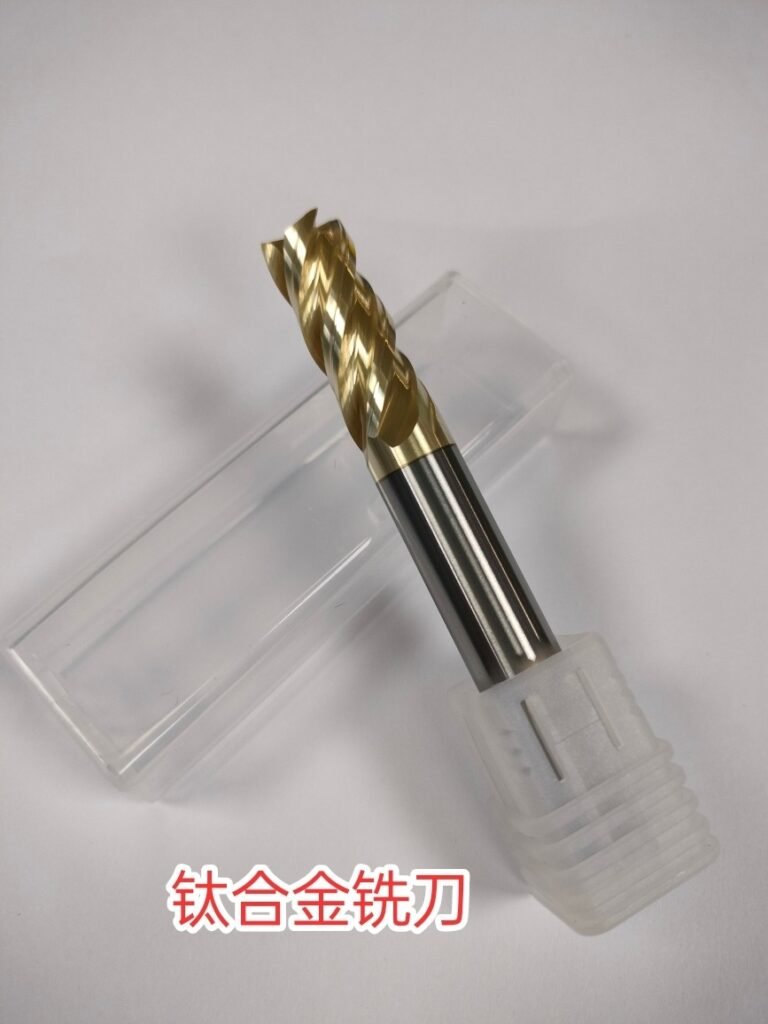
Why Is Titanium Alloy Difficult to Machine?
Titanium alloys such as Grade 5 (Ti-6Al-4V / TC4) and TB13 are widely used in aerospace, medical, marine and energy industries due to their excellent strength-to-weight ratio and corrosion resistance.
However, these outstanding mechanical properties also make titanium one of the most difficult engineering materials to machine.
Typical machining challenges include:
- Low thermal conductivity causing excessive heat concentration
- High chemical affinity leading to built-up edge and tool adhesion
- High cutting force and vibration
- Severe notch wear
- Rapid flank wear
- Poor chip evacuation
- Short tool life
These issues often result in unstable machining quality, reduced productivity and increased manufacturing costs.
Why Conventional End Mills Fail?
Many standard carbide end mills are originally designed for carbon steel or stainless steel.
When machining titanium alloys, they frequently suffer from:
- Edge chipping
- Excessive vibration
- Built-up edge
- Plastic deformation
- Thermal cracking
- Premature coating failure
Therefore, titanium machining requires tools specifically optimized for heat resistance, chip evacuation and vibration suppression.
Ti Solutions — Recommended Milling Strategy
Instead of relying solely on cutting parameters, successful titanium machining is achieved through the combination of:
- Tool Geometry
- Carbide Grade
- Coating Technology
- Cutting Strategy
- Cooling Method
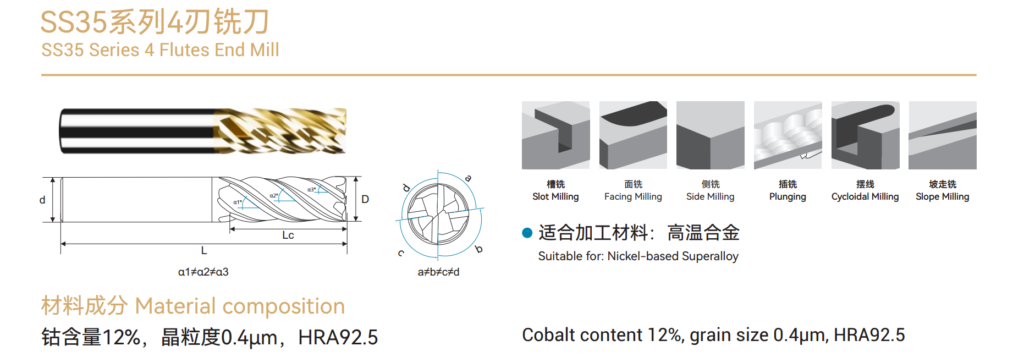
1. Variable Helix Geometry
Unequally Divided Variable Spirals
A variable helix design significantly reduces harmonic vibration during milling.
Benefits include:
- Stable cutting
- Lower chatter
- Improved dimensional accuracy
- Better surface finish
- Extended tool life
Especially suitable for:
- Thin-wall components
- Aerospace structural parts
- Precision medical components
2. Large Chip Evacuation Groove
Titanium chips are difficult to break and tend to generate excessive heat.
A large flute volume allows:
- Faster chip evacuation
- Lower cutting temperature
- Reduced chip recutting
- Improved machining stability
This becomes particularly important during deep pocket milling and slot milling.
3. Sharp Cutting Edge
Titanium alloys require a low cutting force.
A precision-ground sharp edge:
- Reduces cutting resistance
- Minimizes work hardening
- Lowers spindle load
- Produces higher-quality surface finish
Sharp cutting edges are particularly effective for finishing operations.
4. Nano Composite Coating
Modern nano composite coatings provide:
- Excellent lubricity
- High oxidation resistance
- Superior heat resistance
- Lower friction coefficient
Advantages include:
- Reduced built-up edge
- Better wear resistance
- Longer tool life
- Stable machining at elevated temperatures
5. Ultra-Fine Grain Carbide Substrate
A carbide substrate with:
- 12% Cobalt
- 0.4 μm grain size
- HRA92.5 hardness
provides:
- Higher fracture toughness
- Better edge retention
- Excellent wear resistance
- Improved resistance to micro-chipping
Suitable for:
- Titanium alloys
- Nickel-based superalloys
- High-strength aerospace materials
Recommended Cutting Strategy
For titanium alloy milling, the following practices are recommended:
Use climb milling whenever possible
Reducing rubbing action improves tool life and surface quality.
Maintain constant chip load
Avoid excessive radial engagement while ensuring stable chip thickness.
Reduce heat generation
Heat is the primary cause of tool failure in titanium machining.
Priority should be given to:
- Efficient chip evacuation
- High-pressure coolant
- Stable cutting conditions
rather than simply increasing spindle speed.
Avoid excessive tool overhang
Minimize tool projection to improve rigidity and suppress vibration.
Typical Applications
The above milling strategy is suitable for machining:
- Titanium Bars
- Titanium Plates
- Aerospace Structural Parts
- Titanium Fasteners
- Medical Implants
- 3D Printing Titanium Components
- Precision Titanium Parts
Common Grades:
- Grade 2 (TA2)
- Grade 5 (Ti-6Al-4V / TC4)
- Grade 23
- TB13
Ti Solutions by DINGTUO
At Dongguan Dingtuo Metal Materials Co., Ltd., we understand that selecting the right titanium material is only the first step.
Successful manufacturing also depends on optimized machining strategies, cutting tools and processing know-how.
Our Ti Solutions support customers with:
- Titanium Material Selection
- Machining Recommendations
- CNC Processing Support
- Material Supply
- Technical Consultation
- Customized Titanium Solutions
Helping manufacturers improve productivity while reducing machining costs.