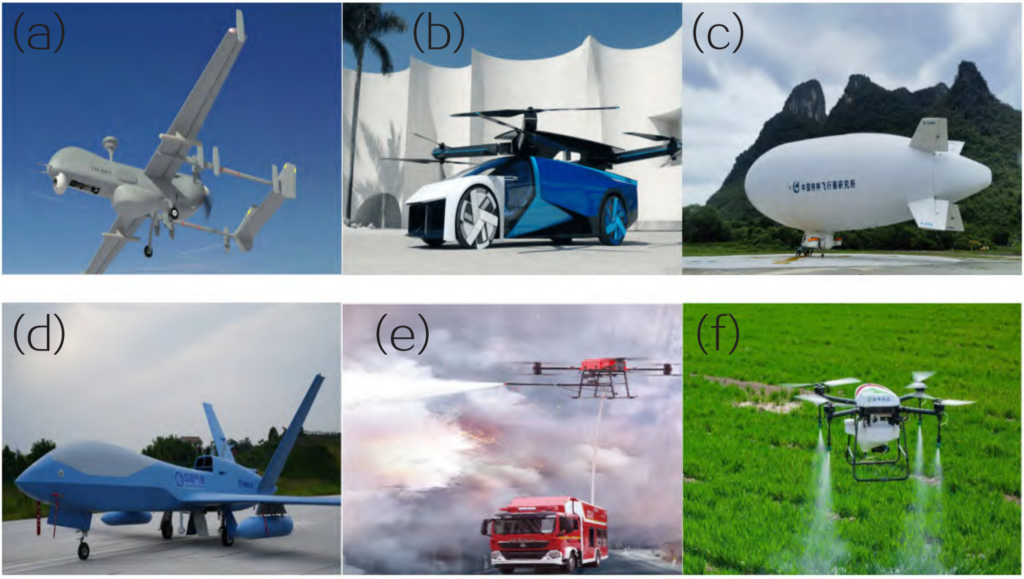
(a)无人机 ;(b)飞行汽车 ;(c)飞艇 ;(d)气象飞行器 ;(e)消防灭火无人机 ;(f)农业喷雾无人机
Low-altitude aircraft:
(a) unmanned aerial vehicle; (b) flying car; (c) airship; (d) meteorological aircraft;
(e) fire-fighting unmanned aerial vehicle; (f) agricultural spraying unmanned aerial vehicle
Due to its unique operating environment and performance requirements, low-altitude aircraft impose stringent criteria on the selection of manufacturing materials. Titanium alloys, characterized by low density, high specific strength, excellent corrosion resistance and favorable high-temperature performance, offer prominent advantages in the manufacturing of low-altitude aircraft. At present, titanium alloys have gradually become a key option for structural materials in the low-altitude aircraft manufacturing sector. They can effectively increase the effective payload of aircraft, improve flight performance, and maintain stable mechanical properties under harsh environmental conditions. For low-altitude aircraft, the application of titanium alloys can enhance maneuverability and durability in complex environments, representing a critical trend for future development. Nevertheless, the application of titanium alloys also faces considerable challenges. Specifically, the high material cost and difficulties in processing and manufacturing are the primary factors currently hindering their large-scale application.
低空飞行器由于其特殊的运行环境和性能需求,对制造材料的选择有着严格的标准。钛合金具有低密度、高比强度、高耐腐蚀性和良好的高温性能,在制造低空飞行器时具有显著的优势。目前钛合金已经逐渐成为低空飞行器制造领域结构材料重要选择,可以有效地提高飞行器的有效载荷,提高飞行性能,能够在恶劣的环境条件下保持稳定的机械性能。对于低空飞行器而言,运用钛合金可以增强其在复杂环境中的可操作性和耐久性,是未来发展的重要趋势。然而钛合金的应用也有很大挑战,主要是其较高的材料成本和生产加工难度,是目前阻碍其大规模应用的主要因素。
Mainstream low-altitude aircraft mainly include the following types:
Unmanned Aerial Vehicle (Drone): A UAV is an aircraft that operates without onboard manual piloting or with semi-autonomous control. Based on differences in structure and application scenarios, UAVs can be further categorized into fixed-wing UAVs, multi-rotor UAVs, vertical take-off and landing (VTOL) UAVs, etc. They are capable of performing a variety of missions including aerial photography, reconnaissance, cargo delivery and scientific research.
Unmanned Helicopter (Helicopter): An aircraft that generates lift via rotors to enable vertical take-off and landing as well as hovering, and is widely used in medical rescue, aerial patrol, tourism and other fields.
Paraglider: A low-speed aircraft with a simple structure that is propelled by air currents, and is primarily used for extreme sports and recreational activities.
Airship (Hot air balloon): An aircraft that operates based on the principle of hot air buoyancy, and is deployed for sightseeing tourism as well as scientific research in meteorology, geography and other disciplines.
Glider: A powerless aircraft that maintains flight primarily relying on updrafts.
Light aircraft: Light aircraft generally refer to small-sized aircraft with low weight and limited passenger capacity, including gliders, ultralight aircraft and other types.
Ultralight aircraft: An ultralight aircraft is a small and lightweight aircraft that typically can carry only one to two occupants, and is mainly used for recreational flying.
主流的低空飞行器主要包括以下几种类型 :
无人机(Drone):无人机是一种无需人工操控或者半自动操控的飞行器,按照结构和用途不同,无人机可细分为固定翼无人机、多旋翼无人机、垂直起降无人机等。可以进行空拍、侦察、运送、科研等多种任务。
无人直升机(Helicopter):利用旋翼产生升力可以垂直起降和悬停的飞行器,广泛用于医疗救援、空中巡逻、旅游观光等领域。
滑翔伞(Paraglider):滑翔伞是一种以气流为驱动,结构简单的低速飞行器,主要用于极限运动和休闲娱乐。
飞艇(Hot air balloon):飞艇是一种利用热空气上升原理飞行的设备,用于观光旅游或气象、地理等科学研究。滑翔机(Glider):滑翔机是一种无动力的飞行器,主要利用气流上升才能飞行。
轻型飞机(Light aircraft):轻型飞机通常指的是小型、重量轻、容量小的飞机,如滑翔机、超轻型飞机等。
超轻型飞机 (Ultralight aircraft) :超轻型飞机是一种小型、轻型的飞机,通常只能搭载一到两人,主要用于娱乐飞行。
Titanium alloys are applied to key components of low-altitude aircraft, such as the wings, propellers and fuselage of unmanned aerial vehicles (UAVs), which substantially improves the overall performance of the aircraft.
First, the high specific strength of titanium alloys allows UAV wings to be designed to be thinner and lighter without sacrificing strength, which contributes to enhanced flight performance. Titanium alloys are also suitable for manufacturing aircraft propellers: their superior corrosion resistance effectively suppresses corrosion caused by long-term service and harsh operating environments, extending service life and reducing maintenance costs.
Second, the high-temperature performance of titanium alloys endows them with significant application value in the engine section of aircraft. The engine is one of the most critical components of an aircraft, and it also operates in the harshest environment. The high-temperature resistance of titanium alloys enables the material to maintain stable performance under the high-temperature operating conditions of aircraft engines, thereby improving the working efficiency and service life of the engine.
钛合金应用于低空飞行器的关键部件比如无人机的机翼、螺旋桨、机身等部位,极大地提升飞行器的性能。
首先钛合金的高比强度使得无人机的机翼可以设计得更薄,更轻而强度不减,这有助于提高飞行器的飞行性能。飞行器的螺旋桨也可以使用钛合金制造,由于其耐腐蚀性优良,可以有效防止由于长期使用和恶劣环境带来的腐蚀问题,延长使用寿命并降低维护成本。
其次钛合金的高温性能使得其在飞行器的发动机部分有着重要的应用价值。发动机是飞行器中最重要的部分之一,也是工作环境最恶劣的部分。钛合金的高温性能使得它可以在发动机的高温环境下保持稳定的性能,提高发动机的工作效率和使用寿命。
The innovative applications of titanium alloys are also embodied in the design and manufacturing processes of aircraft. By adopting novel design concepts and manufacturing technologies, the performance advantages of titanium alloys can be exploited more effectively to improve the overall performance of aircraft. For example, optimized design enables a more compact structure of aircraft, eliminates unnecessary weight, and enhances flight efficiency. Meanwhile, advanced manufacturing technologies such as 3D printing can be employed to fabricate complex titanium alloy components.
The innovative integration of titanium alloys with low-altitude aircraft will substantially improve the performance and service effectiveness of aircraft, meeting the growing demand for complex missions. Owing to these advantageous properties, titanium alloys will enjoy broader application prospects in the future design and manufacturing of low-altitude aircraft.
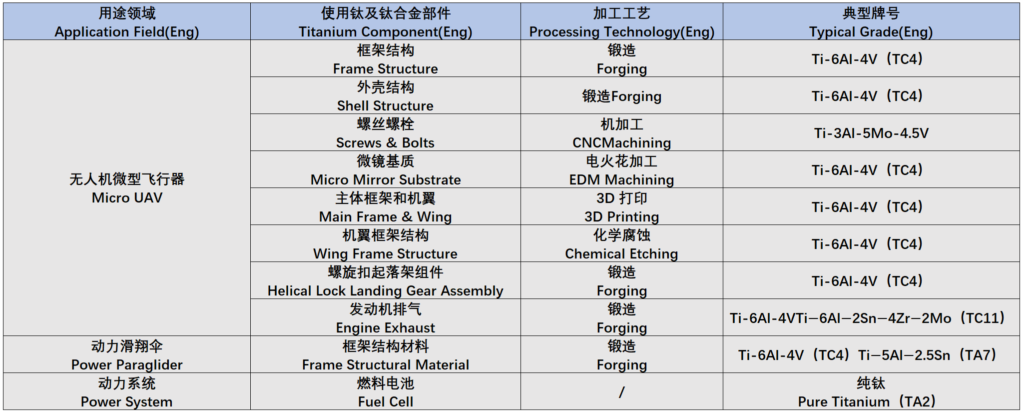
Currently, the following titanium alloy grades are utilized in aircraft:
Ti-6Al-4V (TC4): The most widely adopted α+β titanium alloy, which exhibits excellent mechanical properties and corrosion resistance, and is extensively used in the aerospace field.
Ti-5Al-2.5Sn (TA7): Features good weldability and stability, and is commonly employed for aircraft structural components.
Ti-3Al-2.5V (TC2): Possesses relatively high strength and hardness, and is typically used to manufacture high-pressure pipelines for aircraft.
Ti-6Al-2Sn-4Zr-2Mo (TC11): Demonstrates outstanding strength and toughness at elevated temperatures, and is commonly used to fabricate components such as aircraft engine parts.
Ti-6Al-4V ELI (TC4 ELI): A low-oxygen variant of Ti-6Al-4V, which delivers improved toughness and fatigue strength, and is often used to manufacture aerospace components.
Each titanium alloy possesses specific properties and application scenarios, and the appropriate alloy grade shall be selected in accordance with specific design requirements and working conditions.
钛合金的创新应用也体现在飞行器的设计和制造过程中。通过使用新的设计理念和制造技术,可以更好地利用钛合金的性能优势,提升飞行器的整体性能。例如可以通过优化设计,使得飞行器的结构更加紧凑,减少不必要的重量,提高飞行效率。同时,也可以通过使用新的制造技术,如 3D打印等,来制造出复杂的钛合金零件。钛合金与低空飞行器的创新性结合将会大大提升飞行器的性能和使用效果,满足日益增长的复杂任务需求。而钛合金的这些优点,也将使其在未来的低空飞行器设计和制造中,具有更广阔的应用前景。
目前飞行器采用以下几种钛合金牌号 :
Ti-6Al-4V(TC4):最常用的 α+β 钛合金,具有优异的机械性能和耐腐蚀性,被广泛应用于航空航天领域。
Ti-5Al-2.5Sn(TA7):具有良好的焊接性能和稳定性,通常用于飞行器的结构件。
Ti-3Al-2.5V(TC2):具有较高的强度和硬度,常用于制造飞行器的高压管道。
Ti-6Al-2Sn-4Zr-2Mo(TC11):在高温下具有优异的强度和韧性,常用于制造飞机发动机等部件。
Ti-6Al-4V ELI(TC4 ELI):低 氧 版 本 的 Ti-6Al-4V,具有更好的韧性和疲劳强度,常用于制造航空航天部件。
每种钛合金都有其特定的性能和用途,需要根据具体的设计要求和工作条件来选择适合的钛合金牌号。